
DC MCCB Breaker
-
DC 2 Pole MCCB 125A in 500V (B), 250A in 1000V (B) | Safe & Reliable Circuit Protection
- Rs.12,500
Rs.15,000- Rs.12,500
- Unit price
- per
CNC YCM8-250 DC 2 Pole MCCB -- 125A / 250A A DC-rated molded case circuit breaker available in two configurations: 125A at 500V DC and 250A at 1000V DC. This MCCB is built for high-power DC systems -- solar string combiners, battery banks, and...- Rs.12,500
Rs.15,000- Rs.12,500
- Unit price
- per
-
DC MCCB 125A 1000V | Solar Circuit Breaker
- Rs.4,500
Rs.5,500- Rs.4,500
- Unit price
- per
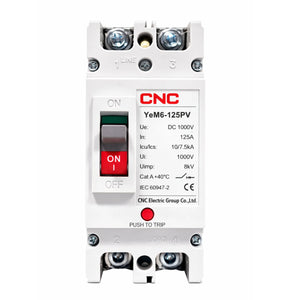
DC MCCB 125A 1000V | Solar Circuit Breaker The CNC Electric YeM6-125PV DC Molded Case Circuit Breaker (MCCB) is engineered to meet the demands of high-voltage direct current (DC) applications, including solar photovoltaic (PV) systems, battery banks, energy storage systems (ESS), and industrial DC...- Rs.4,500
Rs.5,500- Rs.4,500
- Unit price
- per


What is a DC MCCB?
A DC MCCB (Moulded Case Circuit Breaker, DC-rated) is a polarised industrial breaker for high-current DC photovoltaic, battery, and EV-charging applications — rated 125 A to 250 A at 500–1000 V DC. Used at the main DC isolation point of commercial solar systems (downstream of the combiner box, upstream of the inverter), where the prospective short-circuit current exceeds an MCB's 6 kA Icu. CNC YCM8 (125 A 1000 V) and YCM3 (250 A 1000 V) are the standard Pakistani DC MCCB SKUs, built to IEC 60947-2.
| Model | Amp | Voltage | Typical PV size |
|---|---|---|---|
| YCM8 (S) | 125 A | 1000 V DC | 30–75 kW PV |
| YCM8 (B) | 125 A | 500 V DC | Battery bank, 24V or 48V string |
| YCM3 | 250 A | 1000 V DC | 75–150 kW PV main |
For smaller PV strings use YCB8/YCB8s DC MCBs. Combine with DC SPD at the combiner box for full lightning protection.
Updated: September 2026 · CNC Electric Pakistan
DC MCCB Breaker — Pakistan Quick Answer (May 2026)
A DC MCCB (Moulded Case Circuit Breaker for DC) protects high-current solar DC circuits, battery banks, and DC motors from overload and short circuit — typically used where DC current exceeds 100 A (above DC MCB range). Unlike AC MCCBs, a DC MCCB uses special arc-chamber design and is polarity-marked. CNC 2026 prices range from Rs. 8,500 (2P 100A DC 500V) for small commercial solar to Rs. 42,500 (4P 400A DC 1000V) for industrial PV plants.
| Solar System | Recommended DC MCCB | CNC Model | 2026 PKR |
|---|---|---|---|
| 10–30 kW commercial solar | 2P 100A DC 500V | YCM1-100 DC | 8,500 |
| 30–60 kW industrial solar | 2P 160A DC 1000V | YCM1-160 DC | 14,500 |
| 60–100 kW PV plant | 2P 250A DC 1000V | YCM1-250 DC | 22,000 |
| 100+ kW industrial PV | 4P 400A DC 1000V | YCM1-400 DC | 42,500 |
DC MCCB vs DC MCB: DC MCB up to 63A → use for residential rooftop solar 1-10 kW. DC MCCB above 100A → use for commercial/industrial PV. Never use AC MCCB on DC circuits — arc cannot extinguish without zero-crossing.
Read also: DC MCB Breakers · DC Surge Protection · DC Fuses
Ensure maximum protection and reliable performance for your DC electrical systems with premium DC MCCB (Molded Case Circuit Breaker) Breakers from cncelectric.pk. Designed for solar systems, battery banks, industrial DC panels, and renewable energy setups, our DC MCCB breakers provide overload, short-circuit, and fault protection for high-current DC circuits.
What is a DC MCCB Breaker?
A DC MCCB Breaker is a high-capacity molded case circuit breaker designed specifically for direct current (DC) applications. It protects wiring, batteries, inverters, and DC-powered equipment from overcurrent, short circuits, and electrical faults, ensuring safe and uninterrupted operation of your DC systems.
Key Features of CNC DC MCCB Breakers:
- Overload & Short-Circuit Protection: Safeguards DC circuits from excessive current and sudden faults.
- Durable Construction: Made from high-quality, heat-resistant materials for long-lasting reliability.
- Fast Tripping Mechanism: Quickly disconnects faulty circuits to prevent equipment damage and fire hazards.
- Wide Application Range: Ideal for solar power systems, DC panels, battery banks, hybrid setups, and industrial equipment.
- Easy Installation: Modular design fits seamlessly in DC distribution panels and enclosures.
- High Current Ratings: Supports various amperage levels to handle heavy-duty DC loads.
- Enhanced Safety: Prevents damage to inverters, batteries, and sensitive DC equipment.
Benefits of Using CNC DC MCCB Breakers:
- Provides reliable protection for high-current DC circuits in residential, commercial, and industrial setups.
- Ensures safety of personnel and equipment from electrical faults.
- Reduces risk of downtime caused by short circuits or overloads.
- Ideal for solar power systems, battery banks, and DC industrial panels.
- Available at competitive DC MCCB prices in Pakistan with premium quality assurance.
With CNC DC MCCB Breakers, you get trusted, efficient, and durable protection for all your high-current DC applications, ensuring safety, reliability, and uninterrupted operation.
FAQs - DC MCCB (Molded Case Circuit Breaker)
1. What is a DC MCCB Breaker?
A DC MCCB (Molded Case Circuit Breaker) is an electrical protection device designed to protect electrical circuits in DC (Direct Current) systems. It is used to interrupt excessive current in case of overloads or short circuits, ensuring the safety of the electrical installation and connected devices. MCCBs are commonly used in solar power systems, electric vehicle chargers, and other DC applications.
2. What is the difference between an AC MCCB and a DC MCCB?
The primary difference between an AC MCCB (Alternating Current) and DC MCCB (Direct Current) lies in the way they handle the current:
- AC MCCBs are designed for alternating current systems, where the current changes direction periodically.
- DC MCCBs are specifically designed for DC systems, where the current flows in one direction. DC MCCBs are built to handle the steady and unidirectional flow of current without the natural zero-crossing that AC MCCBs rely on for fault clearing.
DC MCCBs are more robust in handling short-circuit interruptions because DC arcs are harder to extinguish compared to AC arcs.
3. How does a DC MCCB work?
A DC MCCB uses an electromagnetic trip mechanism to detect overloads and short circuits in a DC circuit. When the current exceeds the rated value, the MCCB trips and disconnects the circuit to prevent damage. It can be reset manually once the fault is cleared.
- Overload Protection: Protects against prolonged overcurrent.
- Short-Circuit Protection: Trips quickly in case of short circuits to avoid damage to equipment.
- Earth Fault Protection: Some DC MCCBs come with additional earth leakage protection to safeguard against earth faults.
4. Why is a DC MCCB important in solar power systems?
In solar power systems, DC MCCBs are essential for:
- Protecting solar inverters: Solar power systems generate DC current, and using a DC MCCB ensures that the system is protected against overloads or short circuits, preventing damage to expensive equipment.
- Safety during maintenance: When maintenance or installation is required, a DC MCCB can safely disconnect the DC side of the solar system, reducing the risk of electric shock.
- Complying with electrical standards: Many international standards require the use of DC MCCBs for solar installations to ensure safety and reliability.
5. What are the technical specifications of a DC MCCB?
Some key technical specifications to consider for a DC MCCB include:
- Rated Current (A): The maximum current that the MCCB can handle without tripping under normal conditions.
- Breaking Capacity (kA): The maximum fault current that the MCCB can safely interrupt.
- Rated Voltage (VDC): The maximum voltage that the MCCB can withstand in a DC system.
- Tripping Curve: The characteristic curve that determines how quickly the MCCB will trip under different overload conditions (standard curves include B, C, D, etc.).
- Poles: DC MCCBs are available in single-pole, double-pole, or three-pole configurations, depending on the requirements of the system.
- Mounting Type: Can be panel-mounted, rail-mounted, or din rail-mounted.
6. How do you size a DC MCCB?
The size of a DC MCCB should be based on the following:
- Current Rating: Match the rated current to the maximum continuous load of the circuit.
- Fault Current: Ensure the MCCB's breaking capacity is sufficient to handle potential short-circuit fault currents in the system.
- Application Type: For sensitive equipment like inverters or DC chargers, the MCCB should be selected with a delay characteristic suited to prevent unnecessary tripping during inrush currents while protecting against serious faults.
7. What is the difference between an overload and short-circuit protection in DC MCCBs?
- Overload Protection: This mechanism trips the MCCB when the current exceeds the rated value for a prolonged period, protecting the circuit from overheating and damage.
- Short-Circuit Protection: This mechanism responds to very high fault currents and trips the breaker almost instantaneously to prevent catastrophic damage to the system and minimize fire hazards.
8. Can a DC MCCB be used in both residential and industrial applications?
Yes, a DC MCCB can be used in both residential and industrial applications:
- Residential: Typically used in solar energy systems, battery storage systems, and home electric vehicle chargers.
- Industrial: Used in larger systems such as solar farms, DC motor control systems, and industrial power supplies.
9. How do I maintain a DC MCCB?
To ensure the longevity and reliability of a DC MCCB:
- Regular inspection: Periodically check for signs of wear, damage, or corrosion.
- Test operation: Perform operational tests to verify the trip function under normal and fault conditions.
- Cleaning: Keep the breaker clean and free from dust or dirt that could affect its operation. Use a soft cloth to wipe it down.
- Ensure proper wiring: Confirm that the breaker is properly installed with the correct wire sizes and torque values.
- Replace when necessary: If the breaker has been tripped repeatedly or shows signs of internal damage, it should be replaced to ensure continued protection.
10. What are the safety features of a DC MCCB?
- Arc Extinguishing Mechanism: DC MCCBs are designed with advanced arc-extinguishing features to handle the unique characteristics of DC currents.
- Manual Reset: After tripping, the breaker requires manual resetting, ensuring that the fault is addressed before re-energizing the circuit.
- IP Rating: Some DC MCCBs come with an Ingress Protection (IP) rating, indicating their resistance to dust and water, which is important for outdoor and harsh environment installations.
- Temperature Rating: The DC MCCB is built to operate efficiently within a specified temperature range to avoid tripping due to overheating.
11. Can a DC MCCB be used for battery protection?
Yes, a DC MCCB is ideal for battery protection in DC systems, particularly in solar energy setups and other energy storage systems. It can protect both the battery itself and the circuit from potential overcurrent or short-circuit faults that could cause damage to the battery cells or wiring.
12. How do I install a DC MCCB?
- Step 1: Mount the breaker onto the DIN rail or panel according to the manufacturer’s instructions.
- Step 2: Connect the incoming and outgoing cables securely to the terminals, ensuring that the polarity is respected in DC circuits.
- Step 3: Tighten the terminals to the specified torque value.
- Step 4: Set the current rating and trip settings according to the circuit design.
- Step 5: Test the system to verify proper operation, including manual tripping to check the response.
Related: Browse All DC & Solar Protection Products →