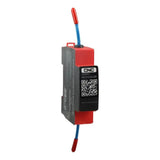

ACB Breakers
-
ACB 3 Pole Air Circuit Breaker 1600A, 2000A, 2500A, 3200A | with Fixed Horizontal Busbar
- Rs.285,000
Rs.316,660- Rs.285,000
- Unit price
- per
Voltage rating clarification (YCW3 ACB) Main pole (busbar) voltage: 400V AC / 690V AC (rated insulation voltage Ui = 1000V, rated operational voltage Ue = 400V/690V). Control circuit / undervoltage trip coil: AC220V (or 110V/24V on order). Any "AC220V" sticker on the front face...- Rs.285,000
Rs.316,660- Rs.285,000
- Unit price
- per

What is an ACB (Air Circuit Breaker)?
An Air Circuit Breaker (ACB) is a low-voltage industrial breaker that uses atmospheric air as its arc-quenching medium, designed for main-incoming protection at 630 A to 6300 A and breaking capacities of 50–100 kA. Built to IEC 60947-2, ACBs sit at the top of the protection hierarchy — upstream of MCCBs and MCBs — protecting factory transformers, generator outputs, capacitor banks and main distribution panels. Available in fixed and drawout mounting; the YCW3 family covers 630–6300 A, 3P/4P, with 80 kA Icu.
| Rating | Icu (kA) | Typical use |
|---|---|---|
| 630–1600 A | 50–65 | Mid-size factory main |
| 2000–3200 A | 65–80 | Large factory / data centre main |
| 4000–6300 A | 80–100 | Substation, heavy industrial |
CNC Electric Pakistan stocks the YCW3 family of ACBs with fixed and horizontal-busbar drawout variants, IEC 60947-2 certified.
Updated: September 2026 · CNC Electric Pakistan
ACB (Air Circuit Breaker) — Pakistan Quick Answer (May 2026)
An ACB (Air Circuit Breaker) in Pakistan is the heavy-duty switchgear used at the main incoming of factories, industrial buildings, hospitals, and large commercial premises — rated 630 A – 6,300 A with breaking capacities of 50–100 kA. It sits at the top of the electrical hierarchy: above MCBs and MCCBs. ACBs use air as the arc-extinguishing medium and feature programmable trip units (overcurrent, short-time, ground fault). CNC 2026 prices range from Rs. 25,000 (630A fixed) to Rs. 95,000+ (4000A draw-out type).
| Application | Recommended ACB | CNC Frame | 2026 PKR |
|---|---|---|---|
| Small factory 200-400 kVA | 3P 630A 50 kA fixed | YCW1-1000 / 630 | 25,000 |
| Medium factory 400-700 kVA | 3P 1000A 65 kA draw-out | YCW1-1000 | 42,000 |
| Large industrial 700-1500 kVA | 3P/4P 1600A 65 kA draw-out | YCW1-2000 / 1600 | 58,000 |
| Heavy industrial 1500-2500 kVA | 4P 2500A 80 kA draw-out | YCW1-3200 / 2500 | 72,000 |
| Utility / paralleled generators | 4P 3200-4000A 100 kA | YCW1-4000 | 95,000+ |
Quick decision: For Pakistani industrial main below 500 kVA → 630-1000A ACB fixed type. Above 1000 kVA → draw-out type (allows maintenance without shutting down adjacent panel). Always specify trip unit: thermal-magnetic (basic) vs LSI / LSIG (programmable, recommended for factories).
Read also: ACB Buyer's Guide 2026 · MCCB Breakers (15-1600A)
ACB vs MCCB — When to Step Up
| Factor | MCCB | ACB |
|---|---|---|
| Current range | 15 A – 1600 A | 630 A – 6300 A |
| Breaking capacity | 25–100 kA | 50–150 kA |
| Trip unit | Thermal-magnetic (or basic electronic) | Programmable LSI/LSIG, communication-ready |
| Mounting | DIN-rail / panel | Front-of-panel cassette (fixed or draw-out) |
| Cost | PKR 1,200 – 35,000 | PKR 25,000 – 95,000+ |
| Use | Sub-mains, motor protection | Main incomer, generator changeover, paralleled sources |
Fixed vs Draw-Out (Withdrawable) ACB
- Fixed-type: bolted permanently into panel. Cheaper. Maintenance requires shutting down the entire panel. Used for small/budget installations.
- Draw-out type: slides out on rails into "TEST" then "ISOLATED" positions. Maintenance possible without shutdown. Required for critical loads (hospitals, datacenters, telecom). Adds 20-30% to cost.
Trip Units Explained — L / S / I / G
- L (Long-time): overload protection — trips at 110-130% of setting after delay
- S (Short-time): short-circuit selectivity — trips at 2-10× setting with adjustable delay (allows downstream breaker to trip first)
- I (Instantaneous): trips immediately at high fault current (typically 8-15× rated)
- G (Ground-fault): trips at small earth-leakage (typically 100-1200 A) — required for safety in many factories
LSI = standard for factories. LSIG = recommended for hospitals, mosques, schools where earth-fault protection is critical for human safety.
ACB FAQ — Pakistan
Q1: What is the price of an ACB in Pakistan?
CNC ACB prices in 2026 start at Rs. 25,000 for a 630A fixed-type and go up to Rs. 95,000+ for 4000A draw-out. Most-common size for Pakistani 500 kVA factories is 1000A draw-out at Rs. 42,000.
Q2: When do I need an ACB instead of MCCB?
Above 1600 A current OR when you need programmable trip selectivity (LSIG), draw-out maintenance, or communication for SCADA — switch from MCCB to ACB. Below 1600 A with basic trip needs, an MCCB is cheaper.
Q3: Is CNC ACB PSQCA certified?
Yes. CNC YCW1 series ACBs are IEC 60947-2 compliant and PSQCA approved. Type-test certificates available on request.
Q4: What warranty does CNC offer on ACB?
1-year manufacturer warranty on electrical/mechanical defects. On-site commissioning available for orders above PKR 200,000.
Q5: Can ACBs be retrofitted into existing panels?
Yes, but the panel cubicle must accommodate the ACB's frame size. CNC offers frame sizes 1000, 1600, 2000, 3200, 4000, 6300 — choose the smallest frame that meets your current requirement to minimise panel space.
Q6: How often should ACBs be serviced?
Annual inspection: check contact wear, clean arc chambers, test trip unit accuracy. Every 5 years: full overhaul or replacement of moving contacts. CNC provides service kits and spare contacts.
Ensure maximum safety and reliability for your electrical distribution system with CNC Electric ACB (Air Circuit Breakers). Designed for industrial, commercial, and large-scale electrical installations, these breakers provide robust protection against overload, short circuits, and electrical faults. Available in 1600A, 2000A, 2500A, and 3200A ratings, CNC ACBs are suitable for AC 50Hz/60Hz systems and rated voltages of 400V to 690V.
With high-performance 3-pole design and a fixed horizontal busbar, CNC ACBs ensure smooth and safe power distribution, protecting your motors, transformers, and heavy electrical equipment. Engineered for long-term durability, these breakers reduce downtime, enhance safety, and maintain stable operation even under high-load conditions.
Key Features
- High-capacity Air Circuit Breaker for industrial and commercial applications
- Rated current options: 1600A, 2000A, 2500A, 3200A
- Supports AC 50Hz/60Hz systems, 400V–690V voltage range
- 3-pole design with fixed horizontal busbar for efficient load handling
- Protects against overload, short circuit, and electrical faults
- Durable construction ensures long service life and high reliability
- Ideal for heavy machinery, motor control, transformers, and panel boards
Why Choose CNC ACB Breakers?
CNC Electric is a trusted brand in Pakistan for premium electrical components. Choosing CNC ACBs ensures:
- Safe operation of high-capacity electrical systems
- Protection of sensitive equipment and industrial machinery
- Reliable performance under heavy-duty loads
- Reduced maintenance and downtime for industrial and commercial facilities
FAQs OF ACB Circuit Breaker
1. What is an Air Circuit Breaker (ACB)?
- An Air Circuit Breaker (ACB) is a type of electrical switchgear used for protecting electrical circuits from damage caused by overcurrent, short circuits, or faults. It functions by separating contacts in air to interrupt current flow when an abnormal condition is detected.
2. What are the key features of ACB?
- Adjustable settings: ACBs offer adjustable current settings, allowing them to be customized for specific applications.
- Arc extinguishing system: It uses air to extinguish the electric arc formed when the breaker is opened.
- Overload and short circuit protection: Provides protection against overloads and short circuits in electrical systems.
- Easy maintenance: ACBs are designed for ease of maintenance and servicing.
3. Where are ACBs used?
- ACBs are typically used in high-voltage and low-voltage systems, in industries, power plants, substations, and electrical distribution networks to ensure the safety of equipment and circuits.
4. How does an Air Circuit Breaker work?
- ACBs detect an overload or fault condition. When such a condition occurs, the breaker trips, separating the contacts and interrupting the flow of electricity. The arc formed during the contact separation is extinguished by the air surrounding the contacts, preventing damage to the system.
5. What is the difference between ACB and MCCB?
- ACB (Air Circuit Breaker) is used for higher current ratings (up to 6300A) and is often used in larger industrial and commercial applications. MCCB (Molded Case Circuit Breaker) is typically used for smaller current ratings (up to 1600A) and is more common in residential or smaller commercial applications.
6. How do you reset an ACB after it trips?
- After the ACB trips due to an overload or fault, identify the cause of the trip, and once the fault is resolved, you can manually reset the breaker. Simply turn the handle or switch to the "ON" position after ensuring there are no issues with the system.
7. What are the advantages of using an ACB?
- Reliable protection: Protects electrical circuits from damage caused by short circuits and overloads.
- Versatility: Can be used in a variety of industries and applications.
- Efficient arc quenching: Air circuit breakers offer excellent arc-extinguishing capabilities, ensuring minimal damage during fault conditions.
- Cost-effective: Provides affordable protection for high-power circuits, offering both performance and value.
8. What is the lifespan of an ACB?
- ACBs typically have a long lifespan, ranging from 10 to 20 years, depending on factors such as operating conditions, maintenance, and load cycles. Regular servicing can extend the life of the breaker.
9. What maintenance is required for an ACB?
- ACBs require periodic inspection, cleaning, and testing to ensure proper functioning. This includes checking for dust, dirt, and wear on the contacts, as well as ensuring the arc extinguishing system works properly.
10. Can ACBs be used in residential applications?
- While ACBs are more commonly used in industrial and commercial applications due to their higher current ratings, smaller versions of ACBs can be used in residential applications where high power is required. However, MCCBs or MCBs are generally preferred for residential use.
11. How do I select the right ACB for my system?
- To select the correct ACB, consider factors such as the maximum current rating, short circuit protection, voltage rating, and the type of load. Additionally, ensure that the breaker is compatible with your electrical infrastructure.
12. What are the types of ACBs?
- ACBs are available in different types, including:
- Fixed-mounted ACBs: These are permanently installed in the system.
- Draw-out ACBs: These can be removed from the system for maintenance or replacement without disturbing the rest of the system.
📖 Related Guide: Best Circuit Breaker Guide
Related: Browse All AC Protection Products →